
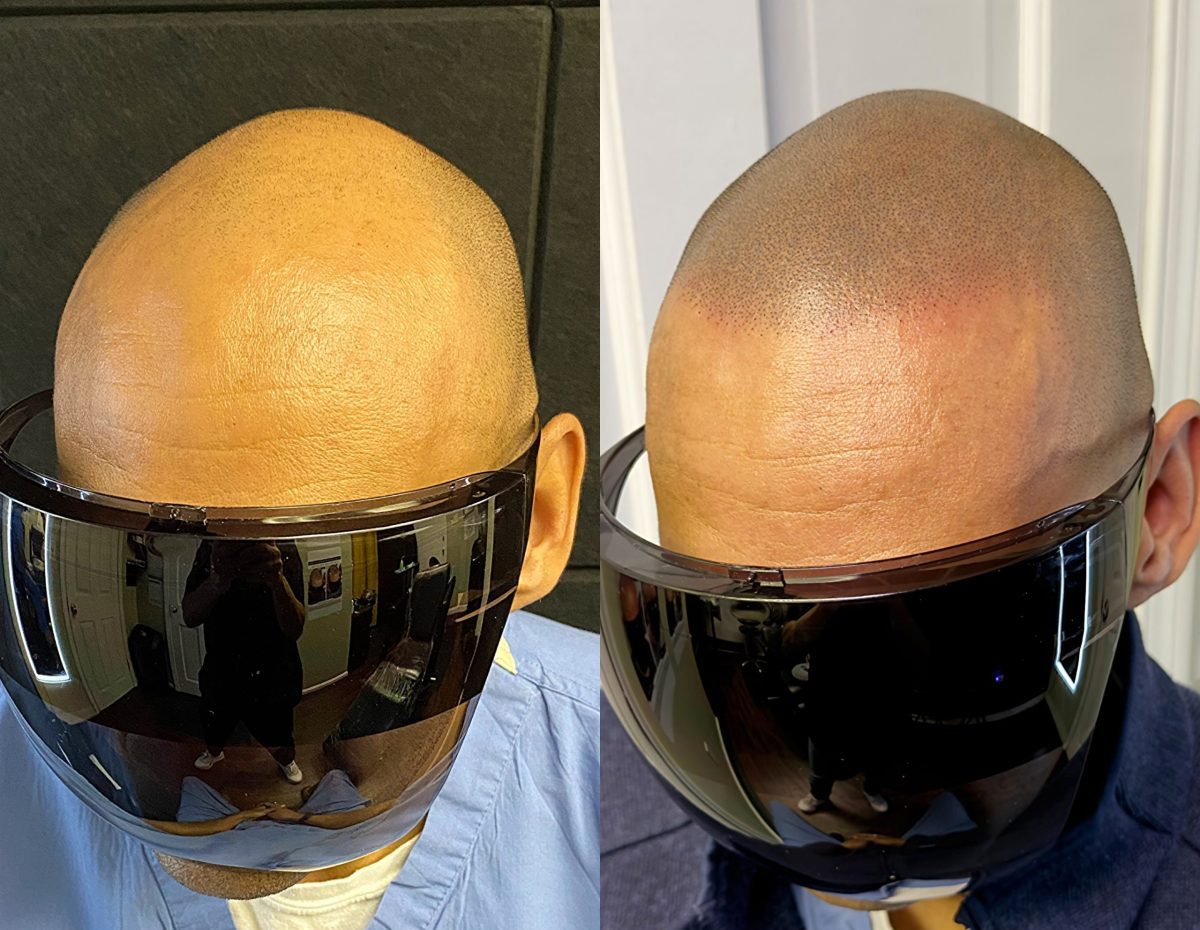

By Steven Rodriguez, SMP Artist at Supreme SMP
You are not wondering whether SMP works in theory. You are wondering whether the healed result actually looks like a shaved head, or whether it looks like something else entirely. This article breaks down exactly what the shaved-head style delivers: the dot density, the hairline, the pigment depth, and the difference between a freshly treated scalp and a fully healed one. By the end, you will know precisely what to expect and whether this style is right for you.
What the shaved head SMP style actually replicates
The goal of the shaved-head style is straightforward: to make a bald or thinning scalp look as though it has been razor-shaved that morning. Scalp micropigmentation deposits small dots of pigment into the scalp, each one sized and spaced to mimic the cross-section of a hair follicle sitting just beneath the skin surface. The result is not a solid block of colour; it is a field of thousands of individually replicated follicles.
Pigment is placed at the epidermal-to-upper-dermal interface, typically between 1.5 and 2 millimetres into the skin. At that depth, each dot reads as a crisp, dark point against the scalp, which is exactly what a freshly shaved follicle looks like up close. Too shallow and the dots blur or fade quickly; too deep and they spread, losing the sharp definition that makes the style convincing. Achieving this depth consistently across the entire scalp is where practitioner skill makes or breaks the outcome.
Dot density builds progressively across sessions. Early sessions begin at roughly 40 dots per square centimetre, establishing the foundational layer. By the final session, density reaches 80 to 100 dots per square centimetre, producing the full, natural-looking coverage of a close-cropped scalp. This pointillist approach means the eye reads it as texture rather than ink, which is the difference between a result that looks like hair replication and one that looks like a smudge.
The hairline: where the style is made or lost
The hairline defines the entire look. For the shaved-head style, it needs to read as natural, not as a hard geometric line drawn across the forehead. A 0.2 mm single-point needle is used at the borders, placing smaller, more widely spaced dots that feather the edge and mimic the soft transition of real hair growth. The body of the scalp uses a 0.25 mm triple-point needle for efficient, even coverage across larger zones.
There is genuine artistry in hairline design. Age, face shape, and skin tone all influence where the hairline should sit and how defined its edge should be. A youthful, lower hairline with a sharper edge suits some clients. A softer, slightly higher line looks more natural on others, particularly as the face matures. This is not a one-size-fits-all decision; the shape that works on a 25-year-old with a square jaw may look incongruous on someone a decade older.
Each hairline is designed individually, drawing on training in visual communications alongside SMP practice. Getting proportions right is as much about aesthetics as it is about technique.
What the healed result looks like, and what it is not
Fresh SMP always looks darker and more saturated than the healed result. Expect the pigment to lighten by around 20 to 40 per cent over the first four weeks as the skin completes its healing cycle. The dots soften slightly at the surface, but the dermal layer retains its definition. After 30 days, what you are seeing is the true, settled result.
The shaved-head style does not simulate a full head of long hair. It replicates a shaved or closely cropped look, the kind you would achieve with a zero guard or a wet razor. If your natural hair is any longer than a number one grade, the SMP will be visible as a contrast beneath it. The style works best when you keep your existing hair shaved tight, allowing the replicated follicles to blend seamlessly with any remaining growth.
Longevity is real but not indefinite. A top-up is typically recommended every one to three years, depending on skin type, lifestyle, and the amount of sun exposure the scalp receives. Sun is the biggest accelerant of fading. Applying SPF 30 to 50 to the scalp daily after the 10-day healing period makes a meaningful difference to how long the result holds. Oily skin, faster cellular metabolism, and certain medications can also shorten the interval between sessions.
Who this style suits and who should think carefully
The shaved-head style is the most versatile application of SMP. It suits male and female pattern baldness at any stage, alopecia areata, alopecia totalis, post-transplant scarring, chemotherapy-related hair loss, and visible scalp scars. If the underlying concern is contrast between the scalp and where hair once was, this style addresses it directly.
It is not the right approach for everyone, however. Active scalp psoriasis, eczema, or acne at the treatment site means waiting for the skin to settle before proceeding. Keloid-prone skin requires a careful discussion before committing, as the needling process carries a small but real risk of raised scarring on susceptible skin. These are not reasons to rule SMP out permanently; they are reasons to have a proper consultation first.
Most treatments run across two to four sessions spaced a few weeks apart, with each session lasting one to five hours depending on the coverage area. Numbing cream is available and can be applied an hour before the session, though it is not used routinely as it can affect pigment retention on some skin types. The session count and spacing exist for good reason: building density gradually produces a more natural, dimensional result than attempting full coverage in a single sitting.
Frequently Asked Questions
How long does shaved head SMP last before it needs a top-up?
Shaved head SMP typically holds well for one to three years before a top-up session is recommended. The speed of fading depends on sun exposure, skin type, and lifestyle. Applying SPF 30 to 50 daily after healing and avoiding prolonged UV exposure are the most effective ways to extend the result between appointments.
Does the healed SMP result look exactly the same as immediately after the session?
No. Fresh SMP appears darker and more saturated than the healed result. Pigment typically lightens by 20 to 40 per cent over the first 30 days as the skin heals. The dots settle into a softer, more natural appearance. The true result is only visible once full healing is complete, around four weeks after the final session.
Can I keep some existing hair and still get the shaved head SMP look?
Yes, but the style works best when existing hair is kept shaved to a zero guard or shorter so that it blends with the replicated follicles. If your natural hair is noticeably longer than the SMP dots, the contrast becomes visible. Maintaining a close shave is part of keeping the result looking seamless and convincing over the long term.
What should I avoid after shaved head SMP treatment?
For the first four days, avoid water on the scalp, shampoo, sweating, and shaving. From days five to ten, wash gently and avoid direct sun. From day ten onwards, apply SPF daily and resume normal grooming. Avoid swimming pools for 28 days. Full healing takes approximately 30 days after the final session.
Who is not a suitable candidate for the shaved head SMP style?
Clients with active scalp psoriasis, eczema flare-ups, or acne at the treatment site should wait until the skin settles. Keloid-prone skin requires careful assessment before proceeding, as needling carries a small risk of raised scarring. A thorough consultation before booking is the appropriate way to confirm suitability for hair replication treatment.