
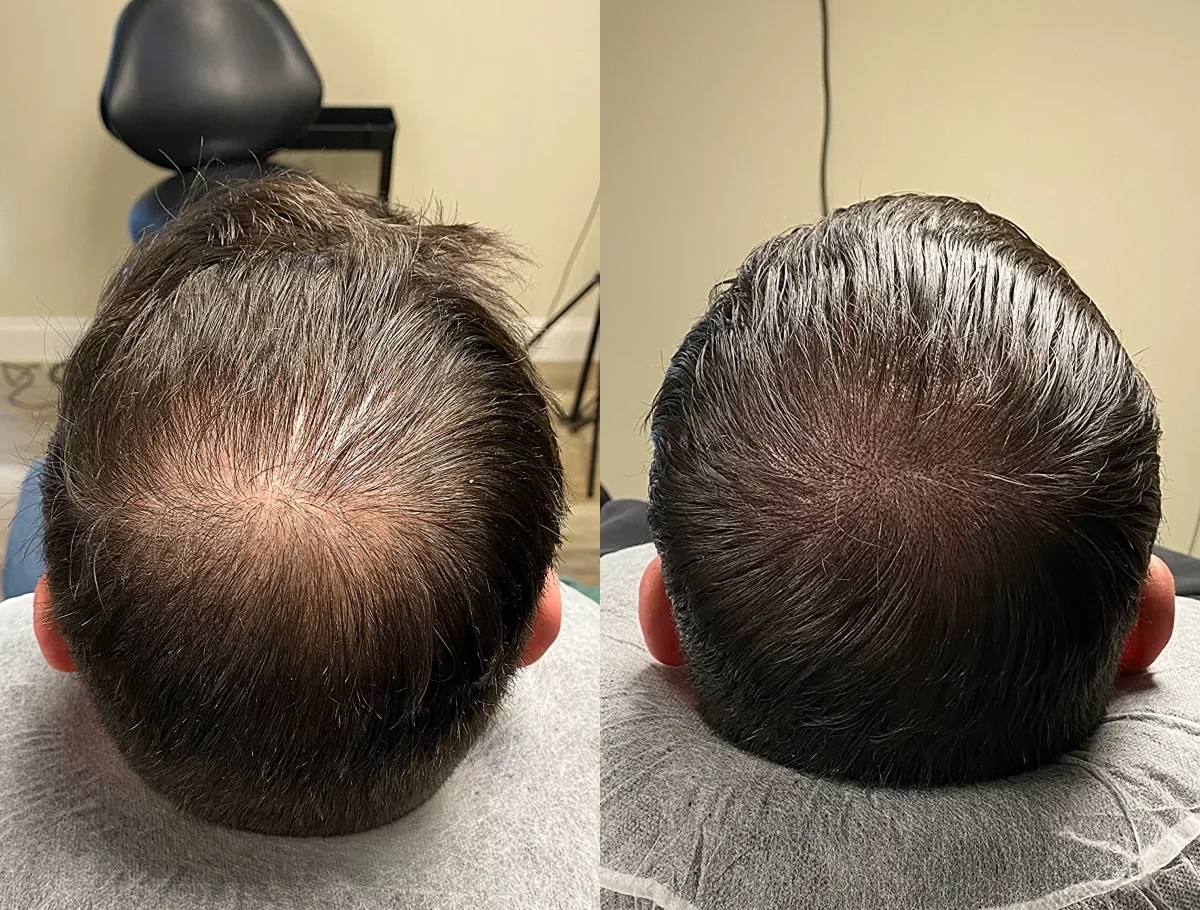

By Steven Rodriguez, SMP Artist at Supreme SMP
You’re thinning on top, you’ve accepted it, and you want to know exactly what you’re signing up for before committing. How many sessions? How long between each one? What does the finished result actually look like? This article answers all of that with a concrete timeline, so you can make a clear-eyed decision rather than guess.
Why SMP density treatment requires more than one session
SMP for male density is not a single-sitting fix. Pigment is deposited into the upper dermal layer of your scalp at a depth of roughly 1.5 to 2 millimetres, using a pointillism technique that replicates the look of individual hair follicles. What is placed in session one is not what you keep long-term.
Your skin heals over the following weeks. Epidermal pigment clears through natural cell turnover in around 27 days, while the dermal layer retains the deeper dots. What you are left with after healing is lighter and more settled than what you saw walking out of the first appointment. That is not a problem; it is the whole point. A practitioner needs to see exactly how your skin has held colour before deciding how much more to add.
Starting at a conservative dot density of around 40 dots per square centimetre, and building progressively to 80 to 100 dots per square centimetre across sessions, means the result looks natural at every stage rather than overworked from the outset. Rushing that process, or compressing it into a single marathon sitting, produces pigment migration, uneven density, and a result that looks artificial under any lighting.
What the session structure looks like in practice
Most men complete their density treatment across two to four sessions, each spaced a few weeks apart. That spacing matters. It gives your scalp time to heal fully and gives the practitioner accurate information about retention before layering further pigment.
Session one establishes the foundation. A lighter pass is placed across the thinning areas, building a base layer that sets the tone and distribution of the treatment. You will leave looking noticeably different, but this is intentionally understated. The goal is to start conservatively and build.
Session two is where density starts to feel real. Once the healed result from session one is assessed, a second pass adds depth, shading, and more defined follicle dots where retention has been lighter. For many men with moderate thinning, two sessions is sufficient. For those with advanced diffuse thinning or larger coverage areas, a third or fourth session allows for further refinement and complete evenness across the vertex, temporal, and occipital regions.
Each sitting typically runs between one and five hours depending on the area being treated. Numbing cream is not routinely used, as it can affect pigment retention depending on skin type and reaction, though it is available if needed and applied an hour before the session starts.
How the healed assessment works between sessions
The gap between sessions is not simply waiting around. It is a diagnostic window. When you return for your next appointment, the practitioner evaluates which zones have retained pigment strongly, which have faded more than expected, and where additional passes are needed. Oily skin types, faster cellular metabolism, and high sun exposure all accelerate fading. Drier skin and consistent SPF use support stronger retention.
A 2025 case series recorded visual density scores averaging 8.7 out of 10 immediately after treatment, settling to 7.7 at the six-month mark. That modest decline is normal and expected, which is why the inter-session assessment is built into the process rather than added on as an afterthought.
Scarring alopecia cases, including post-transplant scarring, tend to show greater fading than androgenetic cases and often benefit from the full four-session structure. If your hair loss is from male pattern baldness, two to three sessions is the more typical range.
The touch-up schedule once your treatment is complete
SMP for density is not a one-time event, but it is low maintenance. Once your final session is done and your scalp has fully healed at the 30-day mark, the result holds well for one to three years before a top-up is typically recommended. Some clients go longer; others return sooner depending on their skin, lifestyle, and how significantly sun exposure has faded the pigment.
The factors that bring clients back earlier are consistent: high UV exposure without SPF protection, oily skin, certain medications, and faster overall skin turnover. Regular use of SPF 30 to 50 on the scalp is the single most effective step you can take to extend the life of your result. It is an essential part of aftercare from day ten onwards.
Touch-up appointments are significantly shorter than the original treatment sessions. The practitioner is not rebuilding from scratch; they are refreshing faded zones and restoring density where pigment has naturally lightened. Most clients need no more than one or two sessions at each touch-up visit.
Understanding the scalp micropigmentation touch-up schedule before you start means you will not be surprised two years in. You go in knowing what the maintenance commitment looks like, and it is modest. A single touch-up every one to three years, combined with a daily habit of applying sunscreen to your scalp, is all that is needed to maintain a result that genuinely changes how you present.
Frequently Asked Questions
How many SMP density sessions does a typical male patient need?
Most men require two to four SMP density sessions to achieve a complete and natural-looking result. The exact number depends on the extent of thinning, scalp type, and how well the skin retains pigment between sessions. Men with moderate diffuse thinning often finish in two sessions; advanced cases typically need three or four.
Why are SMP sessions spaced weeks apart rather than done consecutively?
Spacing sessions a few weeks apart allows the scalp to heal fully and lets the practitioner assess healed pigment retention before adding further passes. Epidermal pigment clears within approximately 27 days through natural cell turnover, so the true settled result is not visible until healing is complete. This assessment prevents over-saturation and keeps the outcome looking natural.
What actually happens during each SMP density session?
Session one places a conservative base layer of pigment dots across the thinning area. Subsequent sessions build density progressively, targeting zones where retention was lighter and refining the overall distribution. Each sitting runs one to five hours depending on coverage area. Pigment dot density increases from around 40 dots per square centimetre in early sessions to 80 to 100 in final passes.
How long does scalp micropigmentation density treatment last before a touch-up is needed?
SMP density results typically hold well for one to three years before a top-up is recommended. Longevity depends on sun exposure, skin type, and aftercare habits. Regular application of SPF 30 to 50 on the scalp from day ten onwards is the most effective way to extend the result. Touch-up appointments are shorter than the original sessions and usually take one to two sittings.
Are there any men who are not good candidates for SMP density treatment?
Men with active scalp acne, psoriasis flare-ups, eczema, or keloid-prone skin are generally not suitable candidates until those conditions are resolved or managed. SMP does not stimulate hair regrowth or affect existing follicles, so it does not address the underlying cause of hair loss. It is a cosmetic solution that reduces the visible contrast between the scalp and thinning hair.